The Product Design Process
Most articles about the product design process are written by designers explaining their craft to other designers. This one is different. It’s written for you—the person paying for it. You need to know what each phase actually costs, what deliverables you should expect to receive, where timelines commonly inflate, and how to tell if the process is working.
The Reality of Product Design Timelines
First, the uncomfortable truth: a real product design process takes 8–16 weeks. Not 2 weeks. Not 4 weeks. If someone is quoting you a faster timeline, they’re either skipping essential steps or they’re very confident in their ability to cut corners later (spoiler: you’ll pay for that confidence).
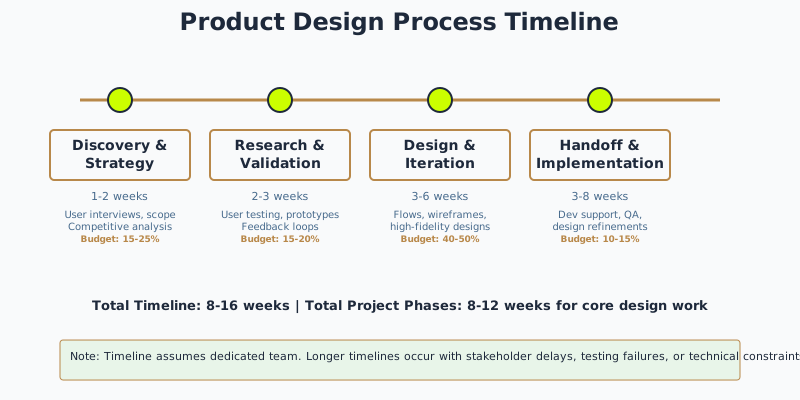
A 2-week design sprint can work if you’re optimizing an existing feature and the scope is tiny. But for anything that involves new user workflows, new interfaces, or exploration—you’re looking at 8–12 weeks minimum for AI, UX, and software teams working together. Add another 2–4 weeks if research is involved or if stakeholder alignment is fragile.
Key Signal
If a designer or agency quotes you 3–4 weeks for a full product design process (including research and iteration), they're either understaffed, overselling confidence, or planning to cut research to make the timeline.
Discovery & Strategy
This is where the process starts—and where most people try to skip ahead.
In discovery, you’re answering: Who are we building for? What problem are we solving? How will we know if it’s solved? What’s the simplest version of this that solves the core problem?
What this phase includes:
- Stakeholder interviews to align on vision and constraints
- User interviews (5–12 people, depending on complexity) to understand pain points
- Competitive analysis—not to copy, but to understand the design landscape
- Current state assessment (if redesigning an existing product)
- Problem definition and success metrics
What you should expect to receive:
- A discovery brief (10–15 pages) documenting findings, user archetypes, and constraints
- A problem statement everyone agrees on
- Success metrics (measurable outcomes, not vanity metrics)
- Scope boundaries (what’s in, what’s out, what’s future)
Timeline: 2–3 weeks
Cost reality: Smaller projects (under $50K total budget) often skip formal discovery and move straight to workshops. Medium projects ($50K–$250K) do light discovery with 2–3 weeks. Large, complex products ($250K+) do rigorous discovery and often extend to 4+ weeks. Discovery is never free—it typically represents 15–25% of total design budget.
Common Failure Mode
Stakeholders push to "just start designing" and skip discovery entirely. The result: you design something beautiful that solves the wrong problem. Then you redesign. Then you redesign again. You end up spending more money, not less.
Research & Validation
After discovery, you have hypotheses. Now you test them.
This phase is where assumptions become evidence. You’re validating that the problem you defined is real, that your understanding of user behavior is accurate, and that your proposed direction actually resonates.
What this phase includes:
- User testing with prototypes (low-fidelity or medium-fidelity, depending on complexity)
- Task-based testing (give users a goal, watch them try to accomplish it)
- Feedback loops and pattern identification
- Competitive product testing (how do users expect this to work based on other products they use?)
- Validation of success metrics
What you should expect to receive:
- Research findings report (what you learned, what changed, what stayed the same)
- Annotated prototypes showing where users succeeded and where they got lost
- Design recommendations informed by user feedback
- Refined success metrics based on what you learned
Timeline: 2–4 weeks
Cost reality: Testing doesn’t have to be expensive. Unmoderated remote testing tools (UserTesting, Maze, Validately) cost $500–$2,000 per round. Moderated interviews run $200–$500 per participant, or $2,000–$10,000 per round. Most projects do 1–2 rounds of validation. Teams with budget constraints often do one round; teams with higher-risk products do two or more.
Questions to Ask
How many users will you test with? Will testing be moderated or unmoderated? What happens if testing shows the current direction is wrong—is there budget and timeline to pivot?
Design & Iteration
Now you have validated direction. Time to design the actual product.
This is the phase that feels like “real” design work—creating flows, wireframes, high-fidelity mockups, component systems, and interaction details. But it’s not exploration anymore; you’re building on a validated foundation.
What this phase includes:
- User flows and sitemap (how users move through the product)
- Wireframes (low-fidelity layouts showing structure, not aesthetics)
- High-fidelity designs (what users will actually see)
- Interaction specifications (hover states, loading states, error states)
- Design system or component library (so development isn’t reinventing every element)
- Design QA (checking for consistency, completeness, edge cases)
What you should expect to receive:
- Complete design files (Figma, not a PDF that becomes outdated)
- Annotated prototypes for developer handoff
- Interaction and animation specs (if your product uses motion)
- Design documentation (typography, spacing, color usage, component guidelines)
- All design assets needed for development
Timeline: 3–6 weeks
Cost reality: This is the longest phase, and where most of the design budget lives. On a $100K project, design and iteration might be $40K–$60K. On a $500K project, it might be $150K–$250K. The variation depends on product complexity, number of user flows, and how many iteration rounds happen with stakeholders.
Key Signal
If the design phase feels quick (2–3 weeks), either the scope is genuinely small, or the team is compressing the feedback and iteration loops. Compressed feedback loops = higher risk of rework later.
Handoff & Implementation
Design is done. Now developers need to build it.
Handoff is not a single moment; it’s an ongoing process. Developers will have questions about edge cases that weren’t designed. Accessibility constraints might require design adjustments. Performance requirements might necessitate simplification. The designer’s job is to be available during implementation to answer those questions without introducing scope creep or “let’s redesign this while we’re at it” moments.
What this phase includes:
- Developer Q&A (answering specific implementation questions)
- Accessibility review (ensuring designs meet WCAG standards)
- Responsive behavior specification (how does this scale from mobile to desktop?)
- Design QA during development (verifying that built product matches designs)
- Small adjustments and refinements as technical constraints emerge
What you should expect to receive:
- Built product that matches the design direction
- Accessibility compliance documentation
- Performance-optimized implementation
- Design system code (CSS, components) that can be reused
Timeline: 3–8 weeks (runs parallel with development)
Cost reality: Handoff and implementation support is often underestimated. A designer should allocate 10–20 hours per week during development. If your development team is 4 engineers and your designer is answering questions asynchronously, that’s realistic. If your design team is 2 people supporting 8 engineers across 3 projects, the feedback loops slow down and problems emerge in QA.
Common Failure Mode
Design team finishes designs, hands off to development, and moves to the next project. Developers have questions. Answers come slowly. Decisions get made without design input. Built product drifts from intended design. By launch, no one's happy with either the design or the implementation.
Where Timelines Inflate
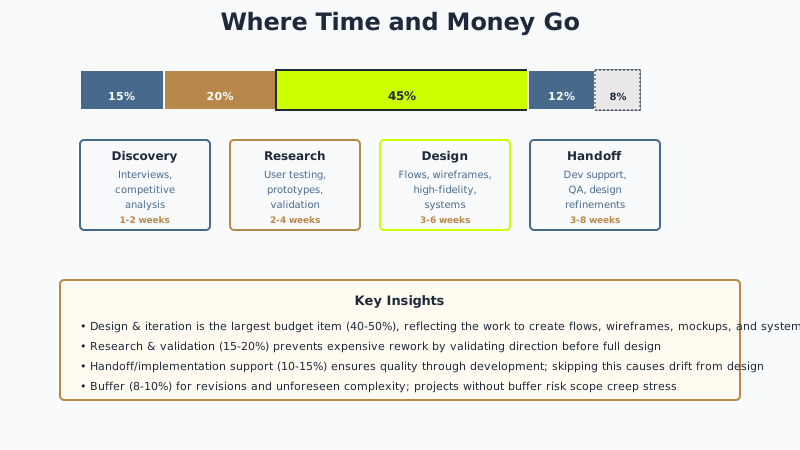
Scope creep. “While we’re redesigning this page, can we also redesign the dashboard?” Yes, but that’s another 4 weeks.
Stakeholder consensus. If 5 people need to agree on design direction and they have different visions, you’ll iterate for weeks. If 1–2 people have decision authority, you’ll move faster.
Testing failures. If user testing shows your core direction is wrong, you don’t skip ahead—you go back and redesign. This can add 4–6 weeks.
Technical constraints discovered late. “The backend can only serve 10 results per page” means your infinite scroll design won’t work. This requires design iteration.
Resource availability. If your designer is also doing other work or supporting other projects, your timeline stretches.
How to Tell If the Process Is Working
Good signs:
- You have clear success metrics and you’re measuring against them
- You’re seeing evidence from user testing, not just designer intuition
- Designs are documented in a living system (Figma), not in static PDFs
- The designer is asking hard questions about what you’re trying to accomplish, not just executing a brief
- Stakeholders agree on direction before design work begins (not after)
Bad signs:
- You’ve done 8 rounds of revisions and still don’t have consensus
- The designer is designing from feedback instead of from user research
- No one’s clear on what success looks like
- Design iterations are adding new features instead of refining existing ones
- The designer is unavailable during development
Related Guides
- Product Design vs. UX Design: What’s the Difference and Which Do You Need?
- What Does a Product Designer Actually Do? A Buyer’s Explanation
- Hire a Product Designer
- UX Design for Startups
- How to Select a Design Partner
- AI, UX, and Software: How They Work Together
- Website Redesign Cost: What Buyers Should Know