Product Designer Hiring Framework
Product design is not graphic design, and it’s not UX research, though it borrows from both. If you get this wrong at hire, you’ll spend months getting the wrong person to do the wrong work.
A product designer owns the entire user experience of a digital product—from information architecture through interaction design, visual design, and everything in between. They think about how people accomplish tasks, not just how things look. They validate assumptions with users. They make tradeoff decisions that should be informed by research and product strategy, not gut feel.
Most hiring mistakes happen because companies confuse product design with one of its adjacent skills. You’ll hire someone brilliant at visual polish who can’t think about task flows. Or you’ll hire a UX researcher who’s exceptional at user interviews but can’t draw an interface. Or worse, you’ll hire someone who calls themselves a “product designer” but really does freelance UI for Squarespace sites.
Similar hiring challenges exist across all design roles—check out how to hire a UI/UX designer for models specific to those disciplines.
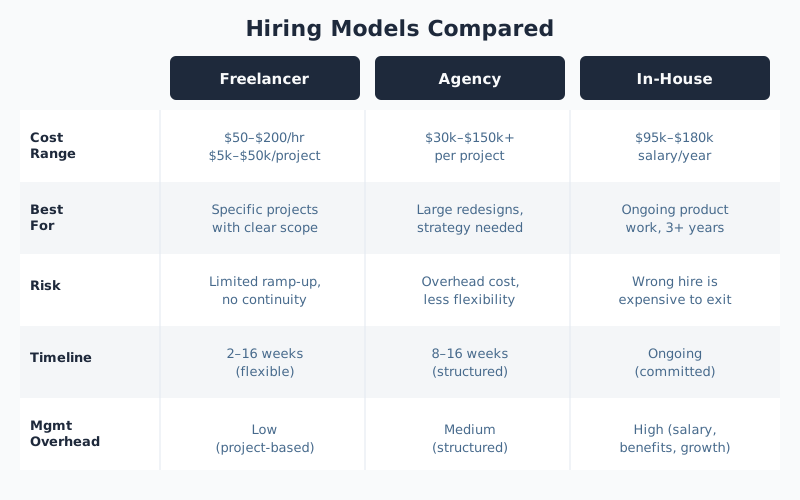
The three models—agency, freelancer, in-house—are not interchangeable. They have different price structures, different risk profiles, and different scenarios where they actually make sense.
Understanding What You’re Hiring For
Before you talk to anyone, you need to know what problem you’re solving.
Are you redesigning an existing product? Building something new? Fixing a specific friction point? The scope completely changes the hire.
If you’re redesigning a product people already use, you need someone who can dig into behavioral data, user research, and competitive products. They’ll need to challenge your assumptions and make recommendations about information architecture and interaction patterns—not just making things pretty. This person needs 4+ years of experience minimum.
If you’re building something new (a startup, a new product line), you need someone who’s comfortable with ambiguity and can work closely with your founder or product manager to validate ideas quickly. They’ll do more scrappy prototyping and user testing. They might need less “depth” experience but more “breadth” experience across different types of products.
If you’re fixing a specific pain point—a confusing checkout flow, a broken onboarding, a dense dashboard—you might need fewer hours and less seniority.
Document what you actually need to happen. Write down the problem, the scope, the timeline, and what success looks like. You’ll use this to evaluate all three models.
The Three Models: Costs, Tradeoffs, and When They Work
In-House Product Designer
Salary range: $95k–$180k/year depending on location, seniority, and equity.
You get consistency, institutional knowledge, and someone who understands your product deeply. They go to your meetings, they see your data, they live in your product. If you have ongoing changes and iterations—which you should—this compounds in value. They can mentor junior designers, establish design systems, and move quickly because they’re embedded in your product development cycle.
The tradeoff: You’re paying for 40 hours a week whether you need 40 hours or 20. You need to manage them, give them professional development, deal with benefits and payroll. If you hire the wrong person, firing them takes time and money. You’re also committing to this role existing in perpetuity.
If you have a product with a 3+ year roadmap and continuous changes, this is the right move. If you’re an early-stage startup and everything might change in 6 months, this is expensive insurance.
Common Failure Mode
Hiring an in-house designer when you don't have enough work. You end up paying for 40 hours/week when you only need 20, or worse—the designer sits idle and becomes expensive overhead. If your roadmap is unclear or might pivot significantly, you're not ready.
The signal you’re ready for this hire: You have a product, it has users, you know what’s broken, and you have a concrete backlog of work.
Freelance/Contract Product Designer
Rate range: $75–$200/hour depending on experience and portfolio. Projects typically run $5k–$50k.
You pay for what you use. You can hire for specific projects or specific stretches of high work. If it doesn’t work out, you’re out the contract value, not a year’s salary. You get someone who’s worked on multiple products, so they bring ideas and patterns from outside your world.
The tradeoff: They don’t know your product. They’re not sitting in your meetings. They might be working on three other projects, so your work isn’t their priority. Quality varies wildly because “freelance product designer” means something different to different people. There’s discovery time built into every engagement. They won’t mentor anyone or build institutional knowledge.
Freelancers are best for:
- Specific projects with clear scope and timeline
- Redesigns where you want an outside perspective
- Early-stage ideas you need to validate quickly
- Filling gaps when you don’t have enough work to justify salary
The signal you’re ready for this hire: You have a specific problem, you know what you want to accomplish, and you have a 6–16 week timeline.
Design Agency
Project range: $30k–$150k+ depending on scope, complexity, and agency tier.
You get a team (designer, researcher, strategist), established processes, and accountability. Good agencies push back when your requirements don’t make sense. They bring research-backed thinking, not just execution. They’ve done this before and have frameworks.
The tradeoff: You pay for overhead. You’re paying for project management, administration, and process that might not apply to your specific problem. There’s often a minimum commitment. You get less customization than freelancing—they’ll run your project through their framework, which sometimes fits and sometimes doesn’t. Quality varies dramatically by agency. Most agencies are good at selling and mediocre at execution.
Agencies work best for:
- Large-scale redesigns where you need research backing decisions
- New products where you need strategy thinking, not just execution
- When your internal team isn’t strong on process and wants structure
- When you want to audit your approach before executing
The signal you’re ready for this hire: You have a big strategic question, significant budget ($40k+), and 3+ months.
How to Evaluate Work: Portfolio and Trial Projects
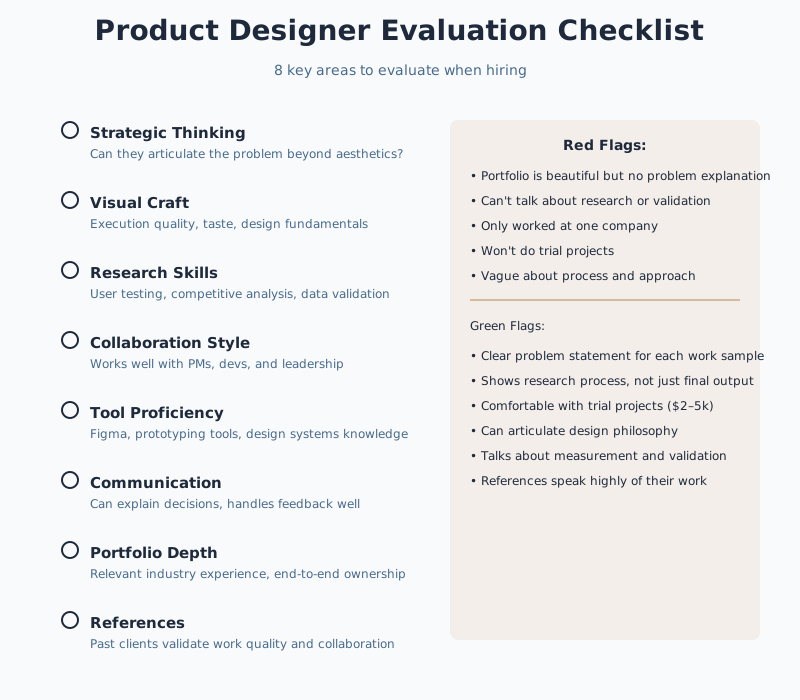
Most hiring decisions get made on portfolio, which is where most hiring mistakes happen.
Key Signal
A beautiful portfolio doesn't mean someone can think strategically. Portfolio alone shows taste and execution—not problem-solving ability, research rigor, or the ability to defend recommendations under pressure.
When you look at a portfolio, what you’re seeing is the final work. You’re not seeing:
- Whether it was built and validated with users
- Whether it met the business goals
- What constraints they were working under
- What the original problem was
- What they recommended but got overruled on
A beautiful portfolio doesn’t mean someone can think. It means someone has good taste and execution skills, which is one part of being a good product designer.
Questions to ask about portfolio pieces:
- What was the original problem? If they can’t articulate this clearly, they might be decorating solutions rather than solving problems.
- What research informed the design? Did they talk to users? What did they learn?
- What did you recommend that didn’t make it into the final product? This shows they know the difference between their ideas and what the business chose to do.
- How did you measure whether it worked? Conversions? User interviews? Time on task?
If they give vague answers, move on.
Look for:
- Work in your industry or adjacent industries. Someone who’s designed for SaaS B2B products should be able to talk about why your marketplace needs different patterns.
- Evidence of design systems thinking. One-off UI design is cheap. Do they show understanding of how designs scale and maintain consistency?
- Different types of work. If their portfolio shows only beautiful marketing sites, they haven’t shipped product.
Common Failure Mode
Skipping the trial project and hiring based on portfolio + interview alone. You end up with someone who interviews well but can't execute, or who's lazy without accountability, or who doesn't deliver on the thinking they promised.
Run a trial project before committing.
Don’t hire someone full-time or for a $50k project without seeing how they actually work.
A good trial project is:
- Specific enough that it has clear success criteria (not vague aesthetic feedback)
- Small enough that it costs $2k–$5k (half a week for a freelancer, 1–2 weeks for an agency)
- Real work that you might actually ship
- Reflective of the actual work you’d do together
Don’t ask for:
- Free or spec work
- Extensive exploration of 10 different directions
- Final polished work (rough is fine—you’re evaluating thinking)
Ask them to:
- Show their process. How will they approach this? What information do they need from you first?
- Do research. Even a small trial should have a research phase—talking to users, analyzing data, looking at your current state.
- Present rough work in progress. You want to see them thinking, not just the final output.
If they won’t do this—if they want to come back with full-color comps without talking to you first—they’re decorators, not designers.
Questions to Ask
Ask every designer candidate: "Walk me through a portfolio project. What research informed the design? What did you recommend that didn't make it into the final product? How did you measure whether it worked?" If they can't answer with specifics, they haven't owned the work strategically.
What to Pay and Avoiding the Traps
For in-house:
- Entry-level (0–3 years, assistant or junior): $60k–$85k
- Mid-level (3–7 years, IC designer): $95k–$135k
- Senior (7+ years, staff or principal): $140k–$180k
- Principal/design lead: $160k–$220k
These are U.S. salaries for 2026. Adjust for your market. San Francisco and New York are 15–25% higher. Remote salaries are converging but still anchored to location-of-work.
Red flags in salary expectations:
- Someone with 2 years of experience asking for $120k. They don’t know their market value.
- Someone in their sixth year asking for entry-level pay. Might mean they’re not strong.
- Huge range given with no context. (“$80k–$150k” doesn’t help you hire.)
For freelancers/contractors:
- Juniors (0–3 years): $50–$85/hour or $8k–$25k per project
- Mid-level (3–7 years): $85–$135/hour or $20k–$50k per project
- Senior (7+ years): $135–$200+/hour or $50k–$100k+ per project
Rates vary by geography and whether they’re in a high cost-of-living area, but less than salary does. A designer in Denver working on a remote basis for a Silicon Valley company isn’t getting a 50% discount.
These are realistic U.S. market rates. Anything significantly cheaper, and you’re either getting very junior work or someone who’s going to rush you.
How to avoid the padding trap:
Bad contractors pad scope. You ask for “redesign the dashboard,” and suddenly it’s a 12-week project with stakeholder interviews and journey mapping.
Get a fixed price. Say, “Here’s the problem, here’s the scope, here’s the timeline—what does this cost?” If they come back with an open-ended estimate, require checkpoints and a cap. See fixed-fee vs. time-and-materials for guidance on contract structures.
Ask them to give you a rough breakdown:
- Discovery: 1 week
- Concept/research: 1 week
- Design execution: 2 weeks
- Revisions: 1 week
If those numbers don’t make sense, push back.
For agencies:
Most agencies aren’t transparent about what drives cost. Typical project: $40k–$80k for a 10–12 week engagement including research, strategy, design, and some level of output (high-fi comps, prototype, or design specs).
But ask what’s included:
- Research scope: How many user interviews? How much stakeholder work?
- Deliverables: Annotated wireframes, high-fi comps, design specs, prototype, or actual code?
- Revisions: How many rounds of feedback before it costs extra?
- Testing/validation: Do they test with users or just hand off the design?
Some agencies charge $30k and deliver only comps. Some charge $80k and oversee implementation. These aren’t comparable deals.
The pitch-deck trap:
An agency might say yes to your budget, then hand back some beautiful slides and call it a project. You get no actual design—just a presentation.
When you contract with an agency, make sure you’re clear: What are you getting? Comps? A functioning prototype? Design system documentation? If you don’t specify, you’ll get the minimum.
Avoiding the “discount” trap:
Cheaper isn’t better. A freelancer at $40/hour who takes twice as long is more expensive than someone at $100/hour. Someone who hands you a design that doesn’t work is free compared to someone who doesn’t.
The people who are genuinely cheap are either:
- Very junior and learning on your dime
- Taking too many concurrent projects and not focused
- Going to cut corners or deliver rushed work
- Based in markets with extremely low cost of living and operating with minimal margin (risky)
You’re not looking for the cheapest. You’re looking for the best value. A designer at $120/hour who makes decisions you can trust and finishes on time is cheaper than someone at $70/hour who goes sideways.
Key Signal
A designer 40%+ below market rate is expensive in disguise: they'll miss deadlines, deliver unfocused work, or take too many concurrent projects to give you attention. True cost is time cost and rework cost, not hourly rate.
The sanity check: If someone’s rate is more than 40% below the market range for their experience level, ask why. The answer usually reveals something you need to know.
Related Guides
- Hiring a UI/UX Designer — Compare in-house, freelance, and agency models for UI/UX specifically
- Design RFP Guide — How to write a design RFP that attracts the right agency
- Website Redesign Costs — Understand what design work costs across project types
- Fixed-Fee vs. Time-and-Materials — Choose the right contract structure for design engagements
- Reference Checks for Technology Partners — Deep dive on how to conduct references with past clients
- How to Evaluate a Technology Partner — Broader framework for vendor evaluation across disciplines
- Technology Partner Selection Process — Comprehensive hiring methodology applicable to design partnerships