Design RFP Framework
Bad design RFPs are everywhere. They’re vague about the actual problem. They list “deliverables” without explaining what they’re trying to accomplish. They ask for 15 different options without a budget. They’re written like legal contracts instead of invitations to thinking partners.
When an agency gets a bad RFP, they either ignore it and propose what they think you need (generic), or they pad the estimate because the scope is unclear. You get either a mediocre solution or an overpriced one. Probably both.
Common Failure Mode
Sending a vague RFP and getting back three completely different proposals. One quotes 6 weeks, one quotes 16 weeks. One includes research, one doesn't. You're comparing apples to oranges and can't make a real decision. The lowest bidder wins, not the best fit.
A good design RFP does one thing: it helps you find an agency that thinks like you and understands what you’re trying to solve. It’s less about perfect specifications and more about shared understanding.
Why Most Design RFPs Fail

The most common mistakes:
Confusion about what design is: You send an RFP asking for “branding, website design, and UX strategy” as if they’re the same service. They’re not. An agency good at brand identity might be mediocre at interaction design. You’re setting them up to overpromise and underdeliver. For clarity on the distinctions, see our guides on what a product designer actually does and product design vs UX design.
Vague success criteria: “We want the new site to be modern, fresh, and engaging.” Every agency will say yes. You’ll get generic work that nobody’s excited about. You should be able to measure whether the design succeeded or failed with something more specific than personal preference.
Backwards prioritization: You list deliverables before problems. You’re asking for “20 high-fidelity wireframes and 2 rounds of revision” when maybe you actually need user research and a recommendation, not wireframes.
Over-specification: You define exactly how the process should work—“kickoff meeting, then 2 weeks research, then 3 weeks design, then design system documentation.” You’re pre-defining a process without knowing whether it’s the right one. Good agencies want to adjust their process to your situation, not stick to a template.
Budget games: You don’t say what you want to spend, which means agencies guess high or low based on their fear of losing the deal. You either get overpriced or underbid work.
Wrong audience: You’re asking designers to respond to a contract-heavy, legalistic RFP. The good ones won’t even bid. The mediocre ones will promise anything to win. You’re filtering for the wrong things.
The Foundation: Problem and Context
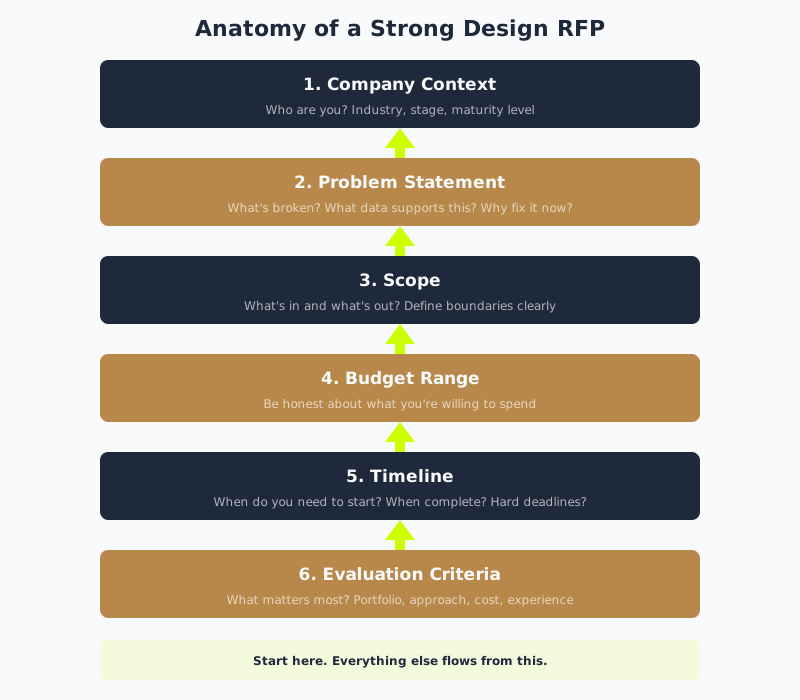
Start here. Everything else flows from this.
Key Signal
A clear problem statement with data is the first indicator that you've actually done thinking, not just decided to redesign on instinct. Agencies can tell the difference immediately. Vague problem = they'll propose something generic.
What problem are you trying to solve?
Not “we need a website redesign.” Real version: “Our conversion rate from free trial to paid is 8%, and user research shows people are confused about which plan is right for them. We need to redesign the pricing page and plan selection experience to increase clarity and reduce decision friction.”
This is one sentence that tells an agency: you’ve thought about the problem, you have data, you know what success looks like.
If you don’t know this yet, don’t send an RFP. Do a discovery call with 2–3 agencies first. Pay them 2–4 hours at their hourly rate to help you scope the problem correctly.
What’s the context?
Include:
- Your business: What do you do? What’s the maturity? (Pre-launch startup, growth-stage, established company?)
- Your users: Who are they? What do they do? Where do they struggle?
- Current state: What exists now? Why isn’t it working?
- Constraints: What’s real? Budget? Timeline? Technology requirements?
- Success metrics: How will you know this worked? (Conversion rate, task completion time, NPS, engagement?) Don’t say “feels more modern.”
One to two pages maximum. You’re giving context, not writing your memoirs.
Define scope boundaries.
What’s in and what’s out?
In:
- Redesign of the dashboard and reporting experience
- Information architecture for the settings section
- Design system components for tables and forms
Out:
- Backend architecture changes
- New feature development
- Copywriting beyond micro-copy
- QA testing
You don’t need to nail everything. But if agencies don’t know whether they’re also doing strategy, they’ll bid 3 different ways and you’ll be comparing apples to oranges.
The Structure: What to Actually Include
Section 1: About Your Organization (1 page)
Keep this brief. Name, industry, funding stage if relevant, headcount, geographic location. One sentence about what you do. No chest-thumping.
Section 2: The Opportunity/Challenge (1-2 pages)
State the problem clearly. Include context:
- “Currently, the checkout flow has a 35% abandonment rate”
- “We’ve tested three messaging approaches and found that users respond better to X”
- “Our competitors are doing Y, and we need to match or exceed that capability”
Real data, not feelings. If you don’t have data, that’s a finding you should tell them: “We haven’t talked to customers systematically about this yet, and that’s part of what we need help with.” This is where structured vendor search and RFPs diverge—RFPs work when you know your problem; structured search works when you’re still figuring it out.
Section 3: What We’re Asking You to Do (1-2 pages)
Not “submit a proposal.” Be specific.
Example structure:
Phase 1: Discovery & Research
- Conduct X number of user interviews with customers who’ve churned
- Analyze current interaction data from product
- Competitive benchmark of 3 comparable products
- Deliver: findings presentation and recommended approach
Phase 2: Design
- Create information architecture and task flows for the new experience
- Design high-fidelity screens for the primary user paths
- Build a component library documenting patterns
- Deliver: annotated designs, design specs, component documentation
Phase 3: Validation (optional)
- Test designs with 5-8 users
- Iterate based on feedback
- Deliver: test findings and final designs
For each phase, be clear:
- What input you’ll provide
- What the agency is responsible for
- What the deliverable is
- How long it should take
This helps them estimate and shows you’ve thought about the work.
Section 4: Timeline & Availability (1 page)
When do you need to start? When do you need it done? Are there hard deadlines?
Questions to Ask
If an agency's proposal timeline is significantly faster than others (8 weeks vs. 14 weeks), ask how. Are they skipping research? Using templates? Staffing it with juniors? What looks like efficiency might be cutting corners.
Be realistic. If you say “5 weeks to complete a full redesign with research,” good agencies will pass. You’re either signaling you don’t know what you’re asking for, or you’re looking for a shortcut they don’t want to be part of.
Section 5: Budget (1 page)
State your budget range. Be real.
“We’re allocating $50–$70k for this engagement” is honest. It tells agencies whether to propose.
If you don’t know, say so. “We don’t have a pre-set budget and want to find the right approach and right partner. What would X scope cost?”
Common Failure Mode
Setting an unrealistic budget hoping agencies will "find a way." They will—by cutting research, staffing with juniors, or removing phases. You get a cheaper result that doesn't solve your problem, then blame the agency instead of the budget.
Don’t lowball hoping someone will accept it. When an agency takes a significantly lower budget, they cut corners. You either get:
- Junior people instead of senior
- Compressed timeline with lower quality
- Cutting research or strategy
- Rushing the process
Agencies build margins into their estimates. If you’re trying to squeeze it, they adjust by cutting value.
Section 6: Agency Evaluation Criteria (1 page)
How will you decide? What matters most?
Example:
- Portfolio work in similar industry/complexity (40%)
- Proposed approach and methodology (30%)
- Team experience and relevant past work (20%)
- Cost (10%)
This tells agencies what you value. Someone who’s bidding on being the cheapest will self-select out if cost is 10%.
Or if you value proven process highly, an agency that pitches as a full-service black-box shop will know they’re not a fit. See how to evaluate a technology partner for a comprehensive framework you can adapt to design vendors.
Section 7: Process & Next Steps (1 page)
How do you want them to respond?
- Max length: keep it to 10 pages (this prevents infinite elaboration)
- Format: PDF is fine, but if they want to do a video walkthrough of their thinking, that’s interesting
- Questions we’ll ask: “If you win, we’ll ask you why you made each recommendation”
- Selection process: “We’ll narrow to 2 agencies for 30-minute calls, then decide”
- Timeline: “Proposals due Friday March 28, decisions by April 11, kick off April 20”
Be specific enough that responses are comparable.
The Execution: How to Get Good Proposals
Who to send this to:
Not the sales team. Send it directly to the person who’ll do the work (creative director, principal designer, strategy lead).
When you send to business development, proposals get filtered and templated. The person who’d actually do the work never reads it.
Key Signal
Before sending RFPs to everyone, call the person who'd actually do your work (not business development). Have a 20-minute conversation. Their questions will tell you if they really understand design or if they're just good at sales. The good ones will self-qualify out if it's not a fit.
Spend 30 minutes researching 3–5 agencies. Look at their work. If one of them has done something similar to your problem, send it there. Email the person who’d lead your project. Say: “I’m including an RFP, but I’m also wondering if you’d grab 20 minutes to talk through whether this is a fit before you invest time in a full proposal.”
Most will say yes. You’ll learn in 20 minutes whether they understand your problem. This saves everyone time.
What to do when proposals come back:
Don’t just score them on a rubric. That’s how mediocre partners win—they understand your evaluation criteria and build to it.
Read the proposal. Does it show they understood your problem? Did they ask smart questions? Did they propose an approach that’s different from what you expected in a good way?
Then call them. 30-minute conversation. Ask:
- Walk me through your recommendation. Why this approach?
- What are you assuming about our business/users?
- What would you recommend we do differently?
- What’s been your experience with companies like ours?
The bad agencies will give generic answers. The good ones will reference things in your RFP, ask clarifying questions, and show thinking.
Red flags in proposals:
- A template response that doesn’t reference anything specific in your RFP
- Promises of unlimited options or unlimited revisions
- A price that’s 50%+ below the next lowest bid
- A guaranteed outcome (“We guarantee 25% conversion rate increase”)
- A process that’s 6+ months for a standard project
- No mention of how they’ll validate work
Green flags:
- They reference specific things from your RFP and ask smart questions
- They propose a phased approach with clear deliverables
- They’re honest about what they don’t know yet (“We’d want to interview 10 users to understand X”)
- Their pricing is transparent (here’s research, here’s design, here’s revisions)
- They’ve done similar work and can show results
Final step: References
Ask for 2–3 references of past clients who hired them for work similar to yours.
Call them. Ask:
- Did they deliver what they promised?
- How was the working relationship?
- If you had to do it again, would you hire them?
- What could they have done better?
Most people won’t bad-mouth an agency on a reference call, but they’ll give you the truth if you ask the third question. Listen for hesitation.
One more thing: if multiple agencies say the same thing about a concern—“they were slower than expected” or “design revisions took longer than estimated”—that’s real feedback. If one agency says something unique, it might be personality-driven.
You’re not looking for perfection. You’re looking for people who:
- Understood your problem
- Proposed something thoughtful
- Have done similar work
- Are honest about what they can and can’t do
- Have satisfied past clients
Pick the one where you think you could have the best working relationship. You’re going to spend 3–6 months together. That matters more than 5% on the estimate.
Related Guides
- How to Hire a Product Designer — Complete buyer’s playbook for hiring designers
- How to Hire a UI/UX Designer — Models for hiring UI/UX specialists specifically
- Website Redesign Costs — Understand what design projects actually cost
- RFP vs. Structured Search — When to use RFPs vs. other vendor selection methods
- How to Evaluate a Technology Partner — Framework for assessing vendor proposals
- Technology Partner Selection Process — End-to-end methodology for vendor evaluation
- Reference Checks for Technology Partners — How to conduct effective reference calls