The AI Consultant ROI Matrix
You’re reading articles about AI. You’re following AI newsletters. You’re listening to podcasts about AI strategy. But you’re still not sure what to do about AI for your business.
A consultant might help. Or a consultant might charge you $25,000 to tell you what you already know, just with a 40-page deck and a nice tone.
This is the core problem with AI consulting: the advice is often obvious once you hear it. “You should focus on customer support automation because that’s where you lose the most time.” That’s obvious. But you needed to pay someone $20,000 to give you permission to pursue the obvious idea.
Here’s how to figure out if you actually need an outside consultant.
The AI Consultant Problem
There are three categories of people selling AI consulting right now:
The technologists: These are engineers and data scientists who’ve decided to go independent or start an agency. They understand how to build AI systems. What they often don’t understand is business strategy or ROI. They’ll build you beautiful things that don’t move the needle. They’re expensive ($150-300/hour) and good at implementation but not strategy.
The MBA consultants: These are people with strategy consulting backgrounds (McKinsey, BCG, Bain alums, or similar). They understand business strategy, ROI, and change management. What they often don’t understand is AI specifically. They’ll give you smart frameworks that apply to any technology, not AI-specific insights. They’re very expensive ($250-500/hour) and good at strategy but potentially slow at recognizing what’s actually technically feasible.
The vendors in consultant clothing: These are people who work for vendors (Microsoft, Google, AWS, implementation agencies) or have revenue-sharing relationships with vendors. Their “AI consulting” is a pre-sales function. They’re trying to sell you something. They’re moderately expensive ($100-250/hour) and often have conflicts of interest.
The problem: all three will charge you serious money. All three will produce professional-looking deliverables. And most of them will give you advice you could have figured out on your own if you’d spent 20 hours reading, thinking, and talking to your team. Before spending money, read our guide on what good AI consulting looks like so you know what to expect.
When You Definitely Don’t Need a Consultant
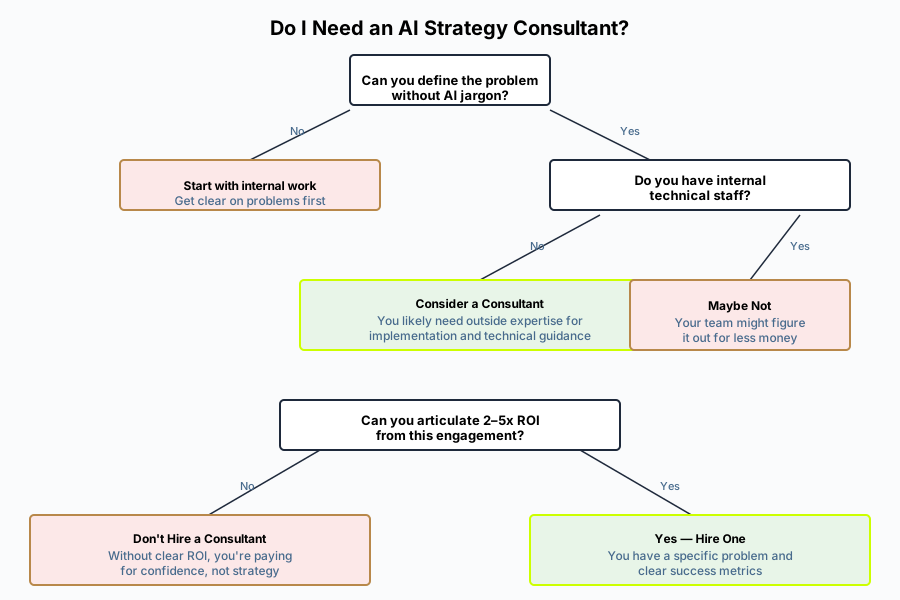
Save your money if:
You don’t have a specific problem you’re trying to solve.
You’ve read some articles about AI and you think it might be useful. You want to “develop an AI strategy.” You don’t have a concrete problem—reduced customer support velocity, inefficient sales process, manual data work, high churn—you just have a vague sense that AI might help.
In this case, a consultant will take your money and produce a vague strategy that recommends a bunch of things, all of which might be useful and none of which you’ll prioritize. You need to first get clear on what your actual problems are. That’s internal work, not consulting work. Do it yourself.
Common Failure Mode
You hire a consultant because you want an AI strategy but you haven't defined what problem you're solving. The consultant, being smart, develops a roadmap that covers all possible AI opportunities: customer support automation, data analytics, content generation, personalization, recruiting tools. It's comprehensive. It's also useless. You can't do all of it. You don't know which to prioritize. The roadmap becomes shelf-ware. You would have been better off spending 10 hours with your team defining your actual problem before spending any money on consulting.
You already have AI projects in progress and they’re moving.
Your team is implementing an AI customer support tool. Your engineering team is exploring generative AI for code assistance. You’re exploring AI for content. You don’t need a consultant to “develop your strategy.” You need to execute what you’re already doing and learn from that execution. The best strategy learning happens in the doing, not in PowerPoint.
You have a tiny budget and limited time.
If you have $10,000 total budget for AI and you spend $8,000 on consulting, you have $2,000 to actually implement something. That’s not a good use of money. Spend the $10,000 on tools, pilots, and execution. Spend your time talking to your team about what problems to solve. Don’t spend it talking to an external consultant about what you already know.
You can hire domain experts directly.
If your problem is “we need to figure out how to use AI for customer support,” you could hire a fractional customer support consultant with AI expertise for $3,000/month for 3 months. Or you could hire a domain-specific consultant (someone who’s built customer support AI before) for the same price. Either way, you’re getting someone who actually understands your specific problem domain. That’s better than a generalist AI strategist.
You already know the answer but you’re looking for permission.
This is the biggest category. You know you should implement an AI customer support solution. You know it’ll save time and money. You’re not asking for strategy advice. You’re asking for someone to tell you it’s the right decision so you can feel confident about it. In that case, don’t hire a consultant. Talk to customers of that tool. Read reviews. Run a pilot. Make your own decision. A consultant will charge you $15,000 to say “yes, you should do it,” which is not a good use of money.
When You Actually Might Need One
You might need a consultant if:
You have a specific, meaty problem that requires expertise you don’t have inside.
You’re in a regulated industry (healthcare, finance) and you need to understand how to implement AI while staying compliant. You have a complex data infrastructure and you need someone who understands both AI and systems integration. You’re trying to decide between building a custom model or buying a vendor solution and you need someone with deep experience in both approaches.
In these cases, an outside expert with specific expertise can save you time and money. But you need to hire based on expertise, not on brand name or credentials.
You’re making a big bet on AI and you need external validation or a second opinion.
You’re going to invest $500,000 in an AI initiative. Your team thinks it’s the right move but you want an outside perspective. You want someone to poke holes in your strategy, identify risks you haven’t thought of, validate your assumptions. That’s a legitimate use of consulting.
But be specific: you’re not hiring them to “develop your AI strategy.” You’re hiring them to validate or challenge the strategy you already have.
You’re genuinely stuck and your team can’t move forward.
You’ve been trying to implement an AI tool for 3 months and you keep hitting walls. Integration is harder than expected. Your team doesn’t know how to set it up. The tool doesn’t work the way you thought it would. You’ve read the documentation and watched the videos and you’re still stuck. In this case, someone with hands-on experience might be able to unlock you in days instead of weeks.
You’re building something custom and you need guidance on architecture or approach.
You’re going to fine-tune a model. You’re going to build a custom integration. You’re going to use AI in a way that nobody in your org has experience with. You need someone who’s done this before to guide you through the gotchas and the right approach.
In all of these cases, what you’re paying for is specific expertise that saves you time or money or both. You’re not paying for someone to think about your business. You’re paying for someone who’s solved the exact problem you have before.
How to Know If a Specific Consultant Is Worth It
When you’re evaluating whether to hire a specific consultant or firm, ask these questions:
Have they done this exact thing before?
If you need help implementing an AI customer support solution in a regulated industry, you need someone who’s implemented AI customer support solutions in regulated industries. Not someone who’s done customer support consulting or regulated industry consulting. The intersection.
If they can’t point to 2-3 specific examples of having done exactly this before, they’re not worth the premium price of a consultant. They’re a smart person who’ll figure it out along with you, which is different.
Can they prove the ROI of their work?
Ask to see case studies with real metrics. “Company X had 200 customer support emails per week. We implemented AI customer support. Now they handle 400 emails per week with the same team.” Real numbers. Real outcomes. If they can’t show this, how do you know they’re good?
Are they willing to work on a performance basis?
If a consultant is confident in their advice, they should be willing to tie part of their compensation to outcomes. “You pay me $15,000 upfront. If we achieve our ROI targets, you pay me an additional $10,000.” A consultant who won’t do this is not confident in their own advice.
Questions to Ask
Ask: "How much of your compensation would you be willing to tie to outcomes?" If they say "I don't do performance-based work," that's fair—some consultants won't. But then ask: "How do you measure success for your clients? How do you know if your recommendation actually worked?" If they don't have a clear answer, they're not measuring impact. They're shipping documents.
Do they have relevant domain expertise or have they worked in your industry?
Someone who’s consulted for 5 SaaS companies will understand SaaS better than someone who’s consulted for 50 companies across 20 industries. Depth beats breadth in consulting.
How transparent are they about what they don’t know?
If you ask them about a specific technical problem and they try to sound knowledgeable when they’re not, that’s a red flag. A good consultant says: “I haven’t done that exact thing before. Here’s how I’d figure it out. Here’s who I’d talk to.” A bad consultant pretends to know everything.
Do they listen more than they talk?
In your discovery call, are they asking about your business or are they pitching you? The best consultants spend 70% of the time listening, 30% talking. The worst consultants are the opposite.
The Alternative: DIY AI Strategy
If you’re not sure about hiring a consultant, try this DIY approach first:
Step 1: Identify your actual problems (2-4 hours).
Get your leadership team in a room. Don’t talk about AI. Talk about what’s inefficient, what’s costing time or money, what’s limiting growth. Write down 5-10 problems. Prioritize them by impact.
Step 2: Research AI solutions to those problems (10-20 hours).
For your top 3 problems, research: Are there AI solutions? What do they cost? What do customers say about them? Read reviews on G2 and Capterra. Watch YouTube reviews. Download free trials. Our guide on AI tools for small business breaks down how to evaluate these properly.
Step 3: Talk to companies who’ve solved these problems (5-10 hours).
Find 3-5 companies similar to yours who’ve implemented AI to solve one of your problems. Email them. Ask them: Did it work? What took longer than expected? Would you do it again? Real conversations with real users are worth way more than a consultant’s theory.
Step 4: Run a pilot (4 weeks).
Pick the most promising solution for your top problem. Run it for 4 weeks with real data and real workflows. Measure whether it actually solved the problem.
Step 5: Make a decision (1 hour).
If the pilot worked, roll it out. If it didn’t work, try a different solution or a different problem.
Total time: 20-40 hours. Total cost: $0. And at the end, you have real data about what works and what doesn’t.
That’s better than any consultant’s strategy document.
Key Signal
If you run the DIY AI strategy process and you actually execute on what you learn, you've just done better consulting than most consultants deliver. The real insight you've gained isn't "what AI should we do?" It's "here's what our team cares about and here's what will actually move the needle for us." That clarity is worth more than any consultant's framework. If you need outside help, bring them in to accelerate execution on what you already know, not to think about your business.
When to bring in a consultant at this point:
If you run the pilot and it doesn’t work, and you don’t know why, then a consultant might help. Or if you run the pilot and it works partially, and you need help scaling it, then a consultant might help. But you’ll hire them to solve a specific problem, not to develop a vague strategy.
The Consultant ROI Calculation

Here’s how to decide:
A good consultant costs $15,000-50,000. The outcomes need to be at least $75,000-100,000 in value (2-5x return) to be worth it.
What counts as value?
- Time savings you can measure (50 hours saved at $100/hour = $5,000)
- Revenue directly created (5 new customers = $50,000)
- Cost avoided (not implementing something that wouldn’t have worked = $20,000)
- Speed advantage (getting to market 2 months faster = $50,000)
If you can’t articulate how you’ll get to 2-5x return from the consultant, don’t hire them.
If the consultant can’t articulate this for you, don’t hire them.
Common Failure Mode
You hire a consultant who promises to help you develop an AI strategy. The engagement costs $30,000. Four weeks later, you have a 40-page PowerPoint about AI trends, use cases, and vendor options. But nowhere in the deck does it say "you should specifically do X because it will generate Y value." The consultant hedges. Everything is conditional. Everything is "it depends." You paid for strategy and got a literature review. A good consultant makes a specific, defendable recommendation and can explain why. If they can't, you're paying for consulting theater.
Conclusion
Most small and mid-size companies don’t need an AI consultant. They need clarity on their own problems, some research time, the willingness to run a pilot, and a decision-making framework.
Hire an AI consultant if:
- You have a specific, complex problem that requires deep expertise you don’t have inside.
- You’re making a large bet and you need external validation.
- You’re genuinely stuck and need hands-on help to unstick.
- You can articulate a clear 2-5x ROI from the engagement.
Otherwise, do the work yourself. It’s cheaper and you’ll understand your own business better.
Related Guides
- What Good AI Consulting Actually Looks Like — How to hire and structure a consulting engagement
- The Honest Guide to AI for Small Business in 2026 — Understand AI fundamentals before talking to consultants
- AI Tools for Small Business: A Buyer’s Guide — Evaluate tools honestly during your DIY research
- How to Select a Technology Partner — Consultants are partners; use this framework to evaluate them
- How to Evaluate a Technology Partner — The vendor evaluation process applies to consultants too