The Startup AI Investment Checklist
Startup founders are getting pitched AI constantly. Investors are asking “where’s your AI?” Competitors seem to be announcing AI features every week. The pressure to do AI is immense. And the pressure is also almost entirely noise.
The uncomfortable truth: most startups building AI features in 2026 are wasting engineering time on something that doesn’t differentiate them, doesn’t defensibly solve a customer problem, and won’t move the needle on their core metrics. They’re doing it because it sounds good in pitch decks and because their investors are asking about it.
But here’s the opportunity: the startups that are thoughtful about AI—the ones asking “does this actually matter?”—are going to outrun the ones that are just chasing the trend.
The Startup AI Trap
The trap works like this:
You have a product idea. Maybe it’s a scheduling tool, or a content tool, or an analytics tool. You spend three months building an MVP. You launch. You get some traction. Then you look at what other companies in your space are doing, and they all have AI features. Their marketing talks about AI. Their product screenshots show AI. Their pitch decks mention AI prominently.
You panic. Your investors ask why you don’t have AI. Your product team feels behind. Your head of product suggests “we should add AI to the summary feature” or “we should use AI to automatically tag content” or “we should build an AI assistant.”
So you do it. You spend 4-6 weeks of engineering time building or integrating an AI feature. You launch it. Your marketing mentions it. It feels good for a month.
Then what? Often, almost nobody uses it. It’s a nice-to-have that doesn’t move your core metrics. You’ve spent 8% of your annual engineering budget building a feature that affects 2% of your users’ experience with your product.
That’s the trap. And it’s especially dangerous for startups because engineering time is your scarcest resource. You have three choices for what your best engineer does this month: (1) build something that directly moves your core metric, (2) fix a critical bug or performance issue, or (3) build an AI feature because it’s trendy and your board asked about it.
Most startups are choosing option 3. That’s a mistake.
Common Failure Mode
Your board asks "where's your AI?" in a fundraising meeting. You panic. You spend 6 weeks building an AI feature. Now your pitch deck mentions AI, which impresses investors who don't understand AI. But your core product is still broken. Your churn is still high. Your retention is still bad. You've optimized for the appearance of progress, not actual progress. The worst part: investors will ask about this AI feature in the next meeting, so you're now committed to maintaining it even though it doesn't move your metrics.
When AI is Worth Your Engineering Resources
AI is worth building or integrating if it meets two criteria:
Criterion 1: It solves a real, frequent problem for your users.
Not “a problem some users have.” A problem your users are hitting regularly. A problem that, if unsolved, creates friction in how they use your product. A problem that, if solved, makes your product noticeably better.
Real examples where we’ve seen this work:
- A project management tool where automatically categorizing tasks based on email saves users 30 seconds per task. If a power user does 20 tasks per week, that’s 10 minutes per week. Over a year, that’s 8+ hours. That’s worth building.
- A content tool where AI generates first-draft variations of headlines so writers can choose from 5 options instead of brainstorming them. If a writer writes 4 pieces per week and spends 10 minutes per piece on headlines, and AI cuts that to 2 minutes, that’s 32 hours per year. With 5 writers, that’s 160 hours per year. That’s worth building.
- A design tool where AI suggests layouts based on your brand guidelines. If designers spend 20% of their time fighting with alignment and spacing, and AI eliminates 50% of that friction, that’s meaningful.
What they have in common: the AI solves a problem that creates friction, frequently. It compounds.
Fake examples that sound good but don’t work:
- “Our design tool will use AI to completely generate designs from a prompt.” Nobody wants that. They want their designs generated, yes, but they also want control. They want to understand the reasoning. They don’t want to throw prompts at a tool and get black-box designs. You’re solving a problem that doesn’t exist.
- “Our scheduling tool will use AI to automatically schedule every meeting for you.” Users don’t want that. They want to understand why a meeting is scheduled at 2pm instead of 3pm. They want agency. They’ll use AI to suggest times, but not to decide. You’re solving a problem your users don’t actually have.
- “Our analytics tool will use AI to automatically interpret all your data.” Users don’t want interpretation. They want their data clean and organized. They want to interpret it themselves. If your data is confusing, that’s a data quality problem, not an AI problem.
Criterion 2: It’s defensible or at least non-trivial to replicate.
If your AI feature is “we use OpenAI’s API to summarize text,” that’s not defensible. Every company can do that tomorrow. It’s not a moat. It’s a feature. It might be a good feature, but it’s not defensible. (This is similar to how you should think about your technology choices more broadly—check the guide on how to select a technology partner for a deeper framework.)
If your AI feature is “we’ve trained a custom model on 50,000 pieces of your data to give you personalized recommendations,” that’s defensible. Competitors would have to replicate your data and your training process. That’s hard.
Most startup AI features fall into the non-defensible category. That doesn’t mean don’t build them. It means know that you’re building a feature, not a moat. You’re doing it because it makes your product better, not because it creates a competitive advantage that lasts.
So the question becomes: is the feature good enough to be worth it, even if it’s not defensible?
Only you can answer that. But be honest about it.
Questions to Ask
If you're considering building an AI feature, ask yourself: "If my competitors have this AI feature in 3 months, does my business get slower? Does my growth rate drop? Do I lose customers?" If the answer is no, you're not building defensible value, you're building a checkbox. Then ask: "Would my users pay extra for this feature?" If they wouldn't, it's not core to your value prop—it's nice-to-have.
When You Should Buy AI Instead of Building It
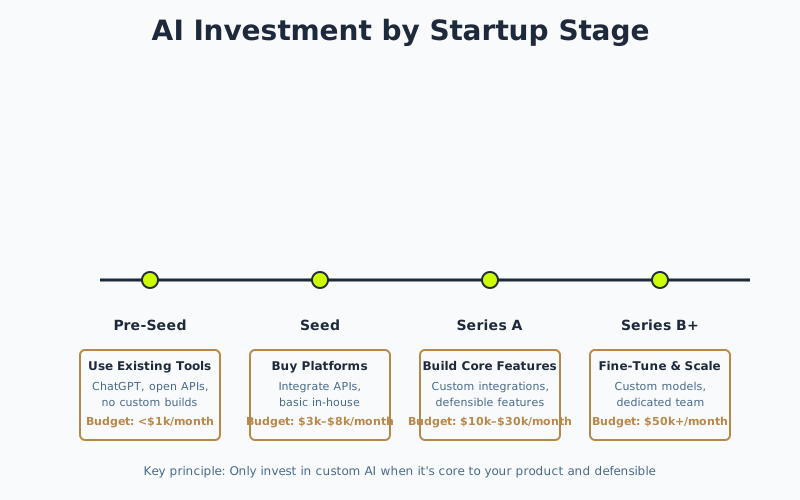
Most startups should be buying, not building.
OpenAI’s API is $0.50 per 1,000 tokens. Anthropic’s API is similar. Specialized APIs for specific tasks (classification, embedding, extraction) cost even less. You can integrate AI features into your product in days, not weeks.
Here’s the math:
If you have a 30-person startup with an average engineer salary of $130k/year, one engineer costs you roughly $11,000 per month in cash (including benefits, equipment, office, taxes). If you spend 4 weeks building an AI feature that a vendor already offers as a plugin, you’ve spent $44,000 in engineering cost.
That plugin might cost $500/month. You’d need to use it for 88 months before you break even. And that’s ignoring opportunity cost—the 4 weeks this engineer could have spent on something that actually moves your metric.
The logic is simple: unless you’re building AI as your core product (you’re an AI company, not a company that has AI), you should buy it.
Specific recommendations:
- For summarization, classification, extraction: Use an API. OpenAI, Anthropic, or specialized services like Hugging Face. Build a thin wrapper around it to fit your product. Time to implement: 3-5 days. Cost to start: $50-200/month.
- For personalization: Use an off-the-shelf tool like Dynamic Yield or use an API to generate recommendations based on user behavior. Don’t train your own models unless you have tens of millions of data points. Time to implement: 2-3 weeks. Cost: $500-2,000/month.
- For content generation (text, images, etc.): Use an API. OpenAI, Anthropic for text; Midjourney, Stable Diffusion for images. Don’t fine-tune or train models. Time to implement: 1-2 weeks. Cost: $200-500/month plus usage fees.
- For chatbots or conversational interfaces: Use platforms like Voiceflow, Intercom with AI, or build a thin wrapper around an LLM API. Don’t build the LLM yourself. Time to implement: 1-2 weeks. Cost: $300-1,000/month.
The exception: if your core product is the AI—if you’re a generative AI company, a model company, a fine-tuning service—then you’re building AI. That’s your product. Everything else is buying.
The Hidden Costs of AI as Your MVP
Some startups are trying to build AI-first products. “We’re not building an analytics tool, we’re building an AI-powered analytics tool.” Or “We’re not building a scheduling tool, we’re building an AI assistant for scheduling.”
This is tempting because AI sounds differentiated. But it has serious hidden costs:
The data problem. AI models are only as good as their training data. If you don’t have training data, your model is mediocre. Users will notice. They’ll use it once, it will give them a mediocre answer, and they won’t come back. So you need to start with significant training data. That’s hard for a new startup. Your competitors (who’ve been collecting data for years) have a massive advantage.
The accuracy problem. AI systems hallucinate. They make up confident-sounding wrong answers. If your core product is AI, you need extremely high accuracy. Users expect your AI to be right. If it’s right 85% of the time, that’s a nice feature. If it’s your core product, that’s a failure. Getting accuracy from 85% to 95% is typically 10x harder than going from 0% to 85%.
The user education problem. Users don’t understand AI. They don’t understand why it sometimes works and sometimes doesn’t. They don’t understand hallucinations or limitations. If your product requires users to understand AI’s limitations to use it properly, you’ve built a worse product. You’ll spend months in customer support explaining why the AI did something weird.
The reliability problem. LLM APIs go down. Your fine-tuned models have edge cases where they fail. You need fallbacks for when AI doesn’t work. You need to gracefully degrade your product when the AI fails. That’s engineering overhead most founders don’t account for.
The cost problem. At scale, API costs become significant. If you’re running 1,000 AI queries per day on OpenAI’s API, that’s $50-100/month. If you scale to 1 million queries per day, that’s $50,000-100,000/month. Can you get users to pay enough to cover that? Often, no.
This doesn’t mean don’t build an AI product. It means go into it with eyes open. The best AI products we’ve seen were built by founders who deeply understood both AI and the domain problem they were solving. Most AI startups skip the “deeply understand the domain” part. That’s why most AI products are mediocre. If you’re working with an outside team to build your AI product, make sure you’re evaluating them properly—read the guide on how to select an AI development partner.
Key Signal
If your AI product's core feature relies on your fine-tuned model, you need millions of data points to compete. If you don't have that data yet, your model won't beat OpenAI's off-the-shelf API. Don't pretend it will. For most startups in year 1-2, you're better off using commodity APIs and building defensibility through workflow, UX, and domain knowledge—not model training.
The Investment Decision Matrix
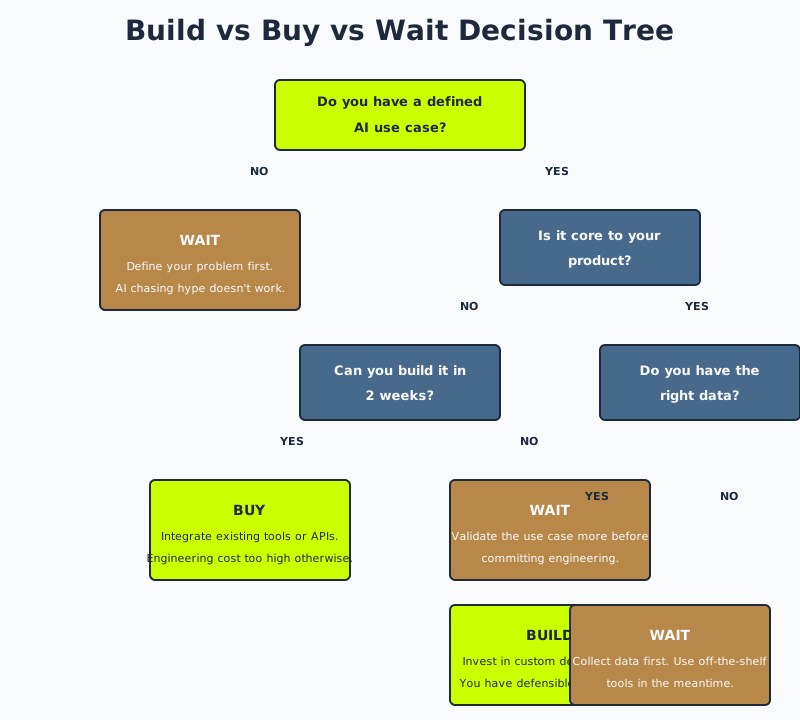
Here’s how to decide:
Ask yourself: Is AI core to my product differentiation or am I adding it because it’s trendy?
If AI is core—meaning users are paying for the AI specifically, meaning without the AI your product doesn’t exist—then AI is worth significant investment. Build it, buy it, or both. Make it exceptional.
If AI is a feature—meaning it makes your product better, but your product exists without it—then:
- Can I build it or buy it in less than 2 weeks? If yes, seriously consider doing it. The upside is high, the cost is low.
- Will it move my core metric by more than 5%? If yes, it’s worth doing. If no, wait.
- Do I have the data to train or fine-tune a custom model? If no, use an API. If yes, consider custom training.
- Can my competitors replicate this easily? If yes, your advantage is temporary. That’s okay. Do it anyway if it’s better for users. If no, that’s a bonus.
- What is the opportunity cost? What would this engineer do instead? If the alternative is less important, do the AI feature.
If AI is a checkbox—meaning you’re adding it to check a box on a board presentation—then don’t do it. Seriously. Spend that engineering time on something that matters.
Common Failure Mode
Your startup built an "AI-powered" feature to impress investors and differentiate from competitors. Users don't care. The feature has a 0.3% usage rate. But now you have technical debt: you're maintaining AI infrastructure, managing API costs, dealing with hallucinations, and your engineering team is frustrated because they could have been fixing the 12 real bugs in your core product. You've created complexity without value. The takeaway: only build AI if users actively want what AI provides.
Conclusion
The startups winning with AI in 2026 are the ones that are boring about it. They use AI when it solves a real problem. They buy when they can, build when they must. They measure whether it actually moved their metric. They don’t overthink it.
The startups losing with AI are the ones chasing the narrative. They’re building AI features because their investors asked about it. They’re talking about AI in their pitch because it sounds good. Their engineers are burned out from building features nobody uses.
Be boring. Be focused. Let the other startups chase hype.
Related Guides
- AI for Small Business — How to evaluate AI when you have limited budget and complexity
- AI Tools for Small Business: A Buyer’s Guide — How to actually compare and pilot AI solutions
- How to Select an AI Development Partner — If you’re building custom AI, how to evaluate the team
- How to Select a Technology Partner — The framework for all technology decisions
- Technology Vendor Due Diligence Checklist — Specific questions to ask any vendor