Why Enterprise Vendor Selection Is Structurally Imbalanced
Enterprise technology vendor selection is commonly framed as a competence question: Who is the most qualified firm for the job? Project sponsors evaluate track records, engineering depth, and case studies. These requirements are necessary. They are not sufficient. The engagements that fail rarely fail for lack of talent.
They fail for lack of incentive awareness.
In complex AI, design, and software engagements, the dominant risks are rooted in incentive misalignment and experience asymmetry between buyers and sellers. Until those forces are surfaced and examined directly, vendor selection remains more fraught — and more likely to fail for non-obvious reasons — than most organizations assume.
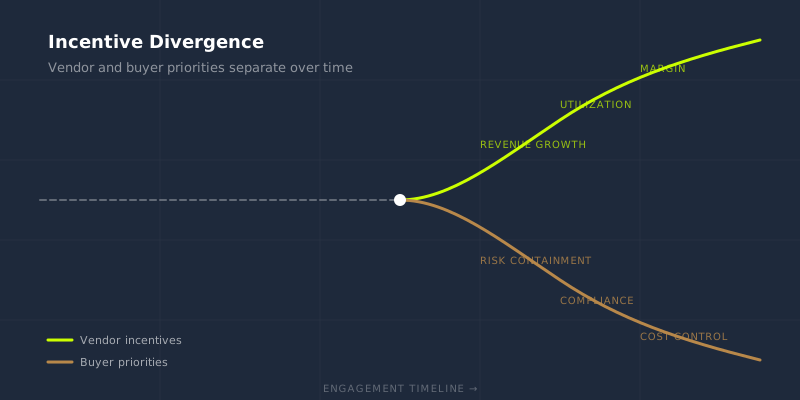
Incentive Divergence: Revenue vs Risk
Technology services firms and design agencies are organized around revenue growth, utilization targets, and margin protection. Compensation structures and leadership incentives reinforce these objectives. In privately held firms, owner economics impose discipline around cash flow and profitability. In investor-backed firms, growth expectations and valuation pressures intensify these dynamics.
Corporate buyers are organized around the opposite. Risk containment. Operational continuity. Cost predictability. Regulatory compliance. Reputational protection. “Get us to the other side in one piece without blowing our budget.” That is the mandate, stated or not.
These incentive systems overlap in limited areas. In critical areas, they diverge.
An aggressive delivery timeline can increase win probability in a competitive sales process. That same timeline can amplify integration and governance risk once execution begins.
A tightly scoped engagement can preserve vendor margins and pricing discipline. It can also reduce adaptability when enterprise complexity emerges.
A vendor under revenue pressure may rationally optimize for account expansion. A buyer may rationally seek cost containment and scope control.
Experience Asymmetry: They Are Better at Selling Than You Are at Buying
Mid-sized development and AI firms conduct structured sales processes continuously. Messaging is tested across dozens of prospects. Pricing architectures, rate cards, and commercial terms are iterated. Objection patterns are documented and preemptively addressed. Case studies are curated to signal certainty and compress perceived risk. The sales function evolves through repetition and feedback.
Most enterprise buyers conduct major vendor selections episodically. A large technology engagement may be evaluated once every several years. The internal team may be sophisticated, but it does not operate in a constant state of procurement refinement. Negotiation strategies are not iterated weekly. Comparative pricing psychology is not stress-tested across dozens of counterparties.
 Photo by Unsplash
In transactional environments, repetition produces structural advantage. The party that executes the exchange more frequently accumulates informational leverage, rhetorical fluency, and pattern recognition.
AI Has Intensified Both Forces
AI has accelerated early-stage prototyping and reduced the cost of generating compelling demonstrations. Proofs of concept can be assembled rapidly, creating an impression of compressed execution risk. Initial outputs are faster, cleaner, and more persuasive than ever.
Simultaneously, AI has exerted downward pressure on segments of the services market. Competitive density has increased. Pricing has compressed. In response, firms rationally adjust: utilization targets rise, bench capacity tightens, and senior oversight becomes more expensive relative to project revenue. Margin sensitivity increases precisely as enterprise buyers assume execution has become easier.
The economic context moves in the opposite direction of the narrative. Demonstrations accelerate. Structural discipline tightens.
AI reduces the cost of illustrating possibility. It does not eliminate enterprise integration complexity, data governance obligations, security review cycles, regulatory exposure, or long-term maintenance burdens. The distance between an impressive demonstration and a resilient production system remains significant. Under margin pressure, that distance becomes more consequential.

What Evaluations Miss
Most vendor evaluations concentrate on visible artifacts: architectural diagrams, methodology frameworks, leadership presence, and curated references. These artifacts are designed for evaluation. They are optimized through repetition. For a deeper framework on how to structure this evaluation properly, see our guide to evaluating technology partners.
Less frequently examined are the economic and organizational drivers that shape delivery outcomes — the degree to which a firm depends on expansion revenue within existing accounts, the percentage of senior engineers tied directly to billable utilization thresholds, the stability of leadership continuity in core technical roles, the firm’s exposure to pricing compression in its primary market segment, and what happens to oversight bandwidth if pipeline velocity slows.
These variables are not peripheral. They are predictive.
An Anomaly in Plain Sight
From a transaction theory perspective, the current structure of enterprise vendor selection is anomalous. In mergers and acquisitions, buyers engage financial and legal advisors to correct informational asymmetry. In real estate transactions, buyers retain brokers. In capital markets, buyers rely on underwriters and counsel.
In enterprise technology procurement — despite the strategic and operational consequences — buyers frequently represent themselves against firms that specialize in structured selling and repeated transaction execution.
Where informational asymmetry and uneven repetition exist, counterbalance is typically introduced. In technology vendor selection, it often is not.
The result is not inevitable failure. It is elevated fragility.

Governance, Not Sourcing
Vendor selection is frequently treated as a sourcing function. It is more accurately understood as a governance decision. It embeds economic incentives, staffing models, and delivery assumptions into the organization for years. It determines not only what is built, but how risk is distributed over time.
The practical implication is not distrust. It is structural rigor.
A durable evaluation does not end with “Are they capable?” It extends to “How are they incentivized?” and “Where do our economic interests diverge?” It requires stress-testing timelines against margin realities, examining staffing elasticity under utilization pressure, and analyzing revenue concentration risk alongside technical competence.
Enterprise AI and software engagements rarely fail because engineers lack skill. They fail because incentives were not examined with sufficient precision, expectations were not stress-tested against economic constraints, and structural asymmetry was left unaddressed.
Vendors specialize in selling services within competitive economic systems. Corporate leaders specialize in operating durable businesses within governance constraints.
These are different disciplines.